Ch. 04 Settling In
Toddler Wakes Up Cold at 3am: Why Only the Second Half
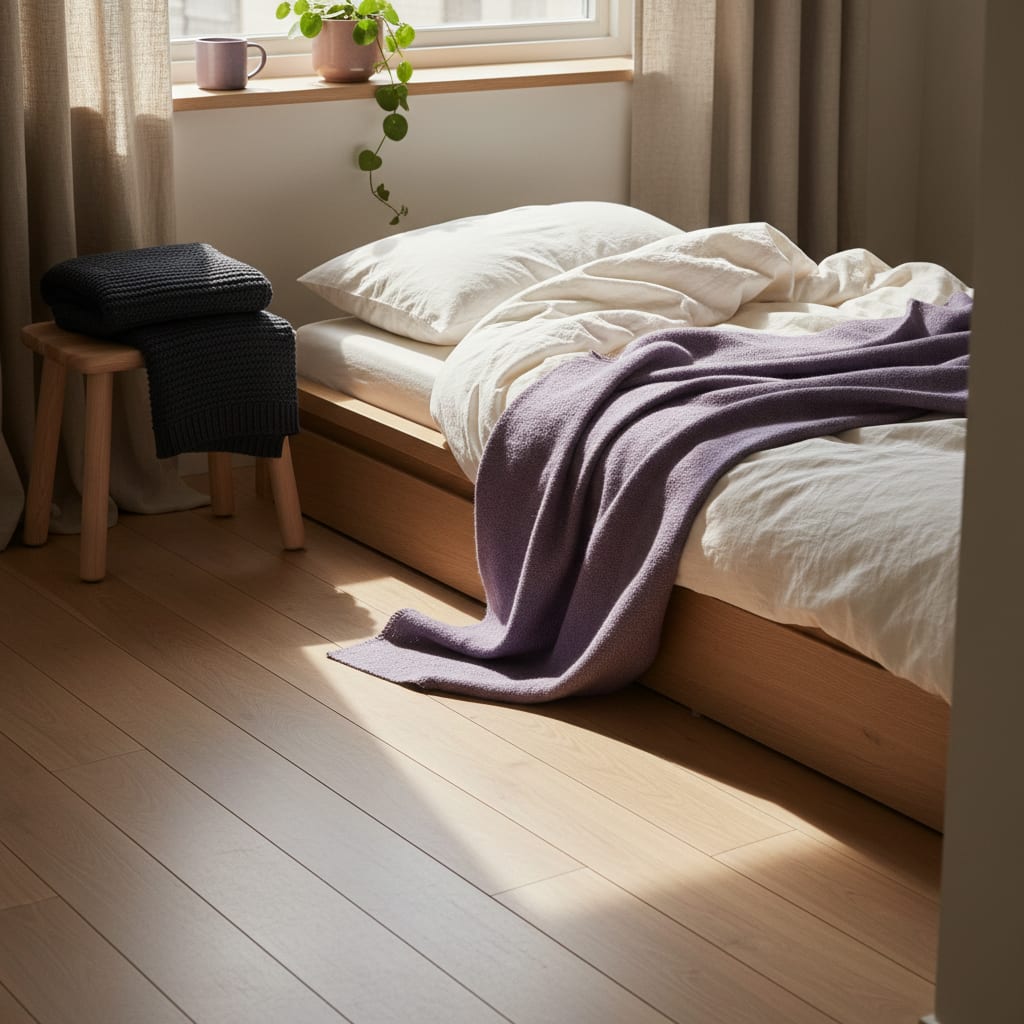
If your toddler goes down warm at seven and wakes shivering at three, it is because three separate things bottom out at roughly the same hour. Their body temperature is at the low point of a daily rhythm. The house is at its low point too — heating cycled down hours ago, outdoor temperature still falling until near sunrise. And by 2am the covers are on the floor, because that is where covers go. None of it is a bedtime problem, so fixing bedtime will not touch it. Fix the layer that cannot be kicked off.
“Cold at night” is one of those problems people solve by turning the thermostat up eight degrees and paying for it every month afterwards, on a budget that just went to one income. So the mechanism is worth being specific about.
Why the cold shows up at 3am and not at 8pm
Body temperature is not a constant your child sits at all night. It is on the clock. NINDS’s plain-language sleep primer says circadian rhythms “direct a wide variety of functions from daily changes in wakefulness to body temperature, metabolism, and the release of hormones”, and describes what happens on the way into sleep itself: in stage 2 non-REM, “your heartbeat and breathing slow, and muscles relax even further. Your body temperature drops and eye movements stop.”
So a sleeping child runs colder than a waking one, coldest in the small hours — exactly when you have stopped heating the house. Two curves, same trough.
The third curve is why this is a second-half problem specifically. The same page notes that deep stage-3 sleep “occurs in longer periods during the first half of the night,” while cycles run “with increasingly longer, deeper REM periods occurring later in the sleep session.” In practice: the first half is the still half, the second is the half where a toddler travels. By 3am they have rotated ninety degrees, migrated to the foot of the bed and left the duvet behind them like a shed coat.
All three together give you a child who is genuinely cold at the one hour when they are least covered, least warm internally, and in the coldest house of their day. Not mysterious — badly timed.
What to change, in order
Cheapest first, because that is the order that matters on one income.
1. Put the warmth on the child, not on the bed. This is the whole fix; everything else is a refinement. A wearable blanket — a sleep sack in a toddler size — cannot be kicked off, cannot migrate, and cannot end up underneath them. Sizes run well past the baby ones: the HALO Sleepsack Toddler Sleeping Bag is one example, sold in 2T and 3T in a choice of warmth weights. TOG is a warmth rating — higher number, warmer garment — and the sack comes with the manufacturer’s own temperature guidance. Use theirs rather than a number off the internet, including mine.
2. Change the pyjamas before the thermostat. Long sleeves, long legs, feet covered. A footed sleepsuit like Burt’s Bees Baby’s solves a surprising share of cold-toddler cases on its own, because feet are what ends up outside everything.
3. Move the bed off a cold wall or out from under a window. Air moves down a cold pane and across the floor; a foot of clearance and a rug cost nothing.
4. Only then look at the heating schedule. If your setback drops the house hard between midnight and 5am, that is the window in question. I am not printing a recommended setback figure — the widely-quoted one is a snippet nobody can produce a working source for. Read your own thermostat’s overnight low, compare it against how the room feels at 3am when you are up anyway, and move in small steps.
5. Do not solve it with a loose blanket in a cot — that swaps a comfort problem for a safety one. See below.
The under-one exception, which runs the other way
If there is also a baby in the house — and on this site there very often is — none of the above transfers. Infant guidance points in the opposite direction, toward less, and it is not a judgement call.
Loose bedding is out. The NIH’s Safe to Sleep programme is blunt: sleeping under “quilts, blankets, sheepskins, and other soft coverings also increases the risk of sleep-related infant death from suffocation and strangulation,” and the safest cot holds nothing but a fitted sheet. The wearable blanket above is the one point that does transfer, in an infant size.
And the risk with a baby is overheating rather than chill. The AAP’s HealthyChildren guidance is to “dress your baby in no more than one extra layer than you would wear”, with the check to run: a baby “may be too hot if they are sweating or if their chest feels hot.” That test works on a toddler too — hands and feet run cool on everybody and tell you almost nothing, while chest and back of the neck are honest. Betteroo’s rundown of what belongs in the sleep space has the whole picture in one place.
When it isn’t the temperature
Rule these out before buying anything; a couple look identical from the hallway at 3am.
- A wet bed. A soaked sleepsuit is cold within minutes, and the second half of the night is exactly when this shows up. If your child was reliably dry and has stopped being, that has its own pattern and its own fixes, and no amount of TOG will touch it.
- A routine that has quietly drifted. If bedtime has moved later over a few months, the whole night shifts with it and the 3am waking may be a schedule artefact rather than a cold one. We wrote about the version where you inherited somebody else’s bedtime routine and never audited it; Betteroo’s toddler bedtime walkthrough is a reasonable baseline to check yours against.
- Illness. Shivering with a fever is not the same thing as being cold, and it is a call to the pediatrician rather than a shopping decision.
Straight about the limits: a sleep plan cannot tell you how cold your landing is at 3am. It is good for the other half of the diagnosis — whether the timing suits the age — so you are not solving a schedule problem with a fleece.
And if you absorb every one of those 3am trips because you are the parent at home, that arithmetic is worth looking at. We ran the numbers on what the broken nights actually cost, and the answer is not nothing.
FAQ: a toddler who wakes cold in the small hours
Why does my toddler only get cold in the second half of the night?
Three things trough together: body temperature at the low end of its daily rhythm, the house at its coldest before dawn, and the restless half of the night, so the covers are already off. The first half has none of those conditions, which is why bedtime looks fine.
What temperature should a toddler’s room be at night?
There is a lot of confident advice on this and very little of it comes with a source you can open, so I am not adding another number to the pile. The more useful test is the child rather than the room: chest and back of the neck warm, not sweating, not cold. Then adjust layers before thermostat.
Can I just put a blanket on my toddler instead of a sleep sack?
Over the age of one, plenty of families do and it is fine — the difficulty is purely practical, in that a blanket is on the floor by 2am, which is the problem you are trying to solve. Under one, loose bedding is a safety question rather than a preference; the fitted-sheet-only rule applies.
Should I turn the heating up overnight?
Last, not first, because it is the only fix on the list with a recurring monthly cost. Layers, footed pyjamas and moving the bed off a cold wall are all cheaper and all address the actual mechanism. If you do change it, move in small steps and check at 3am rather than guessing at 9pm.
Will the night waking turn into a habit?
Only if the visits get interesting. Go in, re-cover, minimal light, minimal conversation, out. Solve the cold in the daytime; keep the night dull.