Ch. 04 Settling In
The Cost of Sleep Deprivation for a One-Income Family
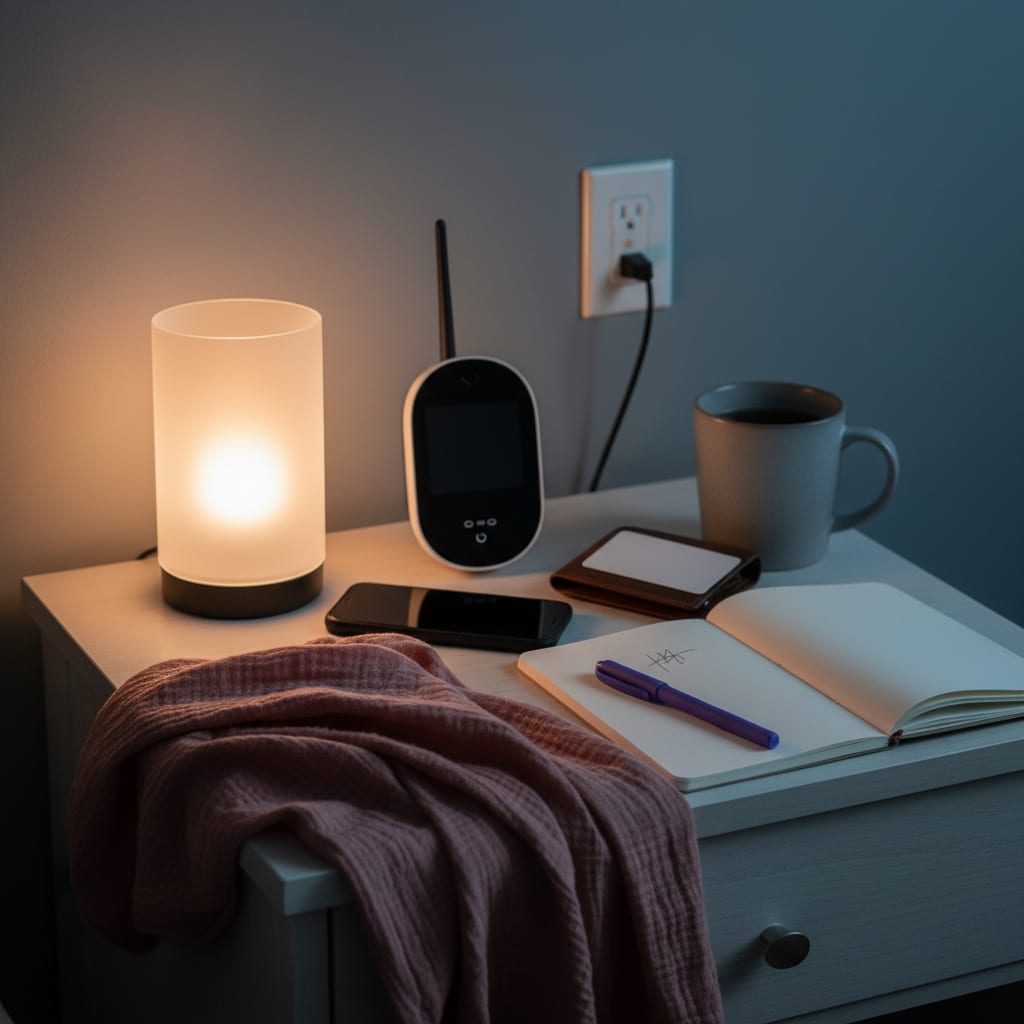
The cost of sleep deprivation, for a one-income family, gets paid in three currencies at once: the at-home parent’s capacity to do the job the household now runs on, the earning parent’s focus at the job the household now depends on entirely, and the quiet money leak of decisions made by exhausted people at 3 a.m. Ask any parent deep in a bad-sleep stretch what they’d pay for a guaranteed full night and you’ll get a disturbingly specific answer. This post runs our usual spreadsheet honesty over the question — what bad sleep actually costs you, and what the fixes cost, from free to four figures — so you can spend at the right end of the range.
The three ways bad sleep bills you
The at-home job degrades first. This site treats staying home as the career move it is, so let’s assess it like one: sleep deprivation is a performance problem in the family’s newest role. The patience that makes hard toddler hours navigable, the judgment that keeps the day structured, the energy that separates a decent day from a survival day — all of it runs on sleep, and there’s no colleague to cover the gap. When you built your first week home around the nap anchor, this is why: the sleep schedule isn’t a parenting nicety, it’s the operating condition of the job.
The paycheck job degrades quietly. A one-income family has concentrated all its earning risk in one person’s performance — and that person is doing 2 a.m. wakings too (they should be; “whoever’s home does the nights” is an erosion, not a policy). Chronically short sleep shows up at work as foggy focus, slower thinking, and shorter tempers; sustained over months, that’s not a small thing to bring to the job your whole budget stands on.
Health is the slow bill. We won’t play doctor here: the general picture, which your physician can make specific, is that chronic sleep deprivation is linked with a raft of physical and mental-health costs — and for parents, exhaustion can shade into anxiety or depression that deserves real care. If either of you is past “tired” into “not okay,” that’s a doctor conversation, not a blog one. It’s also the most expensive line on this page if ignored.
The 3 a.m. money leak
Here’s the lens this site can’t resist: sleep deprivation has a transaction history. Tired brains make expensive small decisions — the surrender takeout on the fourth bad night, the grocery delivery fees of a week nobody could face a store, and above all the 3 a.m. purchases. Every exhausted parent knows the ritual: baby finally down, phone glowing, cart filling with whatever the internet swears fixed someone else’s sleep — another swaddle, another gadget, another white-noise variant. None of it chosen the way you’d choose at noon with a spreadsheet open. Pull three months of statements after a bad-sleep stretch and tag the purchases that were really exhaustion talking; it’s the same exercise as the convenience-premium audit, and it’s usually humbling.
The fix for the leak isn’t more willpower at 3 a.m. — it’s deciding in daylight, with a budget, how you’ll spend on sleep. Which brings us to the menu.
What the fixes cost, honestly
Free: timing and consistency. The largest share of baby and toddler sleep trouble is scheduling — wake windows that drifted out of sync with the child’s age, wind-down routines that vary nightly. Fixing that costs nothing but attention, and it’s where everyone should start. The approach is the one from your first 90 days: observe, anchor, protect.
Cheap: books and basic gear. Sleep books run around $15–25; blackout curtains such as the NICETOWN panels and a white-noise machine like the Yogasleep Dohm are typically in the tens of dollars each. Reasonable buys — bought once, in daylight, not as 3 a.m. talismans. (Whatever you buy, the sleep space itself stays boring: back sleeping, bare crib, per the standard safe-sleep basics your pediatrician will recite.)
The cheap end of personalized: an app, around $20 a month. This is where Betteroo sits on the spectrum — a personalized baby-and-toddler sleep app that takes your child’s age and sleep logs, builds the day’s nap windows and bedtime, and keeps adjusting as they grow. Run the money-math like we would on anything: roughly $20 a month, cancellable, versus the takeout-and-gadget leak a bad month generates — it doesn’t take much fixed sleep to come out ahead. And the honest caveat, as always: it’s a tool, not a spell. It solves schedule-shaped problems, which are common; it won’t out-app teething, illness, or a kid with strong opinions.
Expensive: sleep consultants. Packages commonly run from a few hundred to a couple of thousand dollars depending on the consultant and the level of support. Sometimes worth it — genuinely tangled situations, or families who need a human coach and accountability more than a plan. But it’s the four-figure end of a spectrum whose lower rungs solve the same schedule problems most families actually have. Spreadsheet rule: exhaust the free and cheap tiers first, and never buy the expensive tier at 3 a.m.

The point of the spreadsheet
You can’t buy a full night directly — nobody sells one, whatever the 3 a.m. cart promises. What you can buy is odds: a schedule matched to your child’s actual age, a consistent routine, a night-split agreement that keeps both adults functional, and help scaled to your actual problem. The families who spend well on sleep spend early, cheap, and in daylight. The families who spend badly spend late, exhausted, and one gadget at a time.
FAQ: the cost of sleep deprivation
What does sleep deprivation really cost a family?
Three things: the at-home parent’s capacity in the family’s hardest job, the earner’s focus in the job the budget depends on, and a real money leak — convenience spending and impulse purchases made by exhausted people. Plus the slow health bill, which is a doctor conversation if tiredness has become something heavier.
How much does a baby sleep consultant cost?
Packages commonly run from a few hundred dollars to a couple of thousand depending on support level. Worth considering for genuinely complex situations — but most families’ problems are schedule-shaped and respond to the free and cheap tiers (consistent timing, age-appropriate wake windows) first.
Are baby sleep apps worth the money?
If the problem is scheduling — and it very often is — an app like Betteroo at around $20 a month is the cheapest form of personalized help, and one saved takeout-surrender week roughly covers it. If the problem is medical, or the schedule is right and sleep still isn’t happening, an app isn’t the tool: talk to your pediatrician.
When is parental exhaustion a medical issue?
When it stops being “tired” and starts being “not okay” — exhaustion shading into anxiety, hopelessness, or an inability to function deserves a real appointment, not a better nap schedule. The same goes for the baby: concerns about breathing, feeding, or sleep that never consolidates belong with your pediatrician.