Ch. 04 Settling In
The 45-Minute Nap Ceiling: Why Short Naps Happen
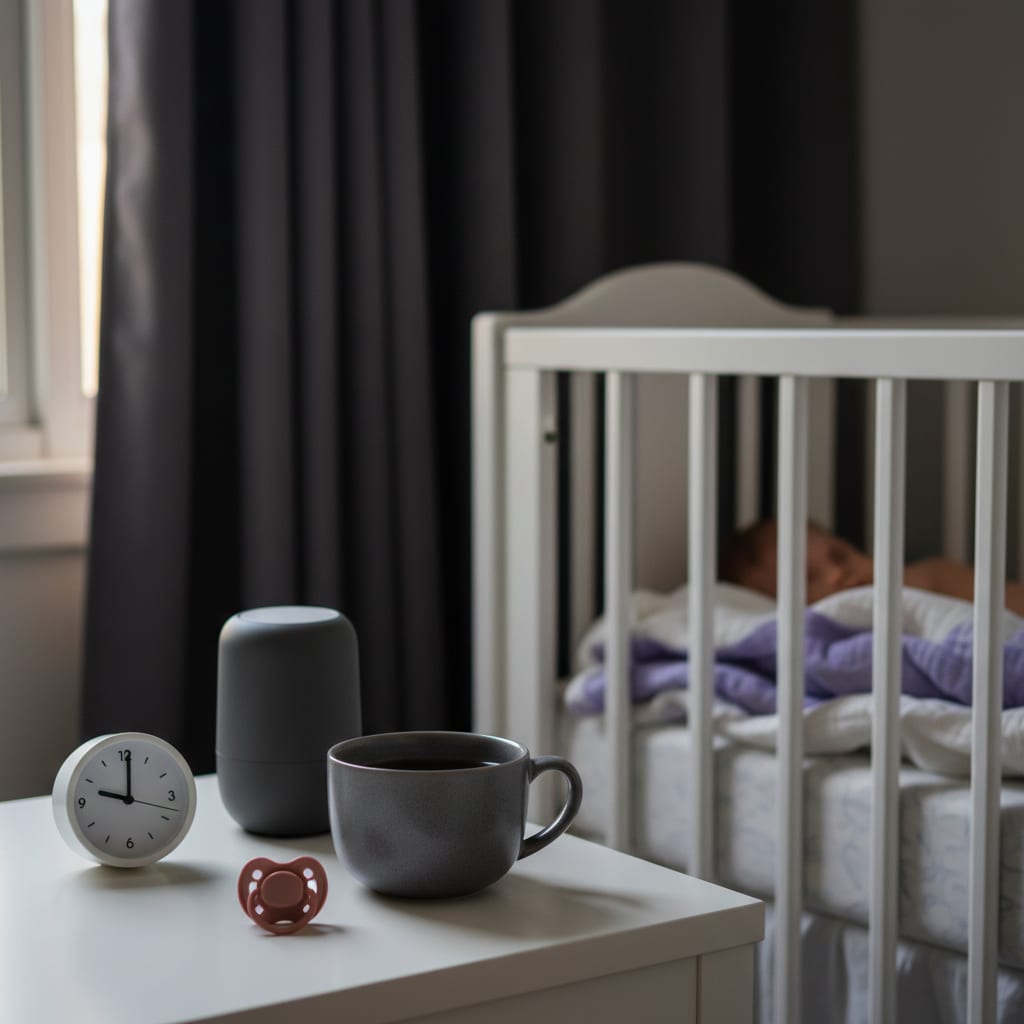
If your baby wakes almost exactly 45 minutes into every nap, nothing is broken. Baby sleep runs in cycles commonly described as roughly 45 minutes to an hour, and a short napper is a baby who surfaces at the end of one cycle and can’t yet link to the next on their own. It’s a skill-and-maturity thing far more often than a habit thing. Some of it responds to timing and the room; some simply resolves with age. Here’s what’s happening, what’s worth trying, and how to run your day when the nap won’t stretch.
The clock isn’t a coincidence
The reason the number is so eerily consistent — 42 minutes, 45, 38, day after day — is that you’re watching a cycle end, not a baby being difficult. At the end of a cycle there’s a brief surfacing toward light sleep. Adults do it too; we roll over and drop back down without knowing it happened. A baby who hasn’t developed that linking skill surfaces, wakes fully, and that’s the nap.
This matters in the first weeks at home, because the natural interpretation — I put her down wrong, I made a noise, I’ve created a bad habit — usually isn’t the explanation. Betteroo’s guide to why short naps happen and when they usually change covers the developmental side in more depth than a transition guide like this one should.
Why it hits new stay-at-home moms so hard
Because you just rebuilt your entire day on top of that nap. In week one at home it becomes the day’s only fixed point — the whole premise of anchoring your first week to naps. Then you discover the fixed point is 40 minutes long, arrives when it likes, and takes with it the shower, the lunch you’d hoped to eat sitting down, and the quiet you’d counted on since 6 a.m. The exhaustion of short naps isn’t really about your child’s sleep total; it’s about a day with no recoverable gap in it.
The four usual suspects
1. Wake windows that don’t match their age. The most common fixable cause by a wide margin. Too little awake time and there isn’t enough sleep pressure to push through the transition; too much and the baby goes down over-tired and wired. Both produce the same short nap — and the window that’s right at four months is wrong at seven, which is why guessing rarely works.
2. The room. Light and noise both matter at the moment of the transition, when your baby is most wakeable. A dark room with steady sound through the whole nap removes two reasons a surfacing baby fully wakes.
3. How they fell asleep. If sleep began in your arms, in motion or on a feed, the surfacing baby looks for those conditions, doesn’t find them, and calls for you. Not a moral failure, and not urgent to change in the newborn months — just a variable worth knowing.
4. Age and development. Some babies short-nap for months, then link cycles almost overnight with nothing changed. Teething, illness, a new motor skill or a regression also shorten naps that had been fine — the 8-month sleep regression survival plan covers that version, where naps were longer and suddenly aren’t.
What’s actually worth trying
Fix timing first. It’s free, it’s the most likely cause, and everything else is downstream. Adjust the awake window before the nap by 15 minutes at a time, hold each change for three or four days, and watch what the nap does. Chasing a different variable every day tells you nothing.
Make the room boring and dark. Darkness helps more than people expect, especially for daytime sleep, and a portable blackout panel is the cheap version — Sleepout makes suction-cup curtains that go up without drilling. For sound, a steady mechanical hum beats a track that loops or shuts off after 30 minutes; the Yogasleep Dohm Classic is the fan-based original and does one thing well. Run it for the whole nap — the transition you care about happens 40 minutes in.
Try the crib hour, or one resettle. Either leave them in the crib for a set period after the wake-up instead of going straight in — some babies resettle into a second cycle, some just chat — or, for a baby who wakes crying, go in before they’re fully awake and help them back down with a hand and a shush. Both are worth a fair week-long trial, and worth abandoning if they become 20 minutes of crying every time.
Stop trying, on purpose, some days. A contact nap on you, in a carrier or in the stroller is a legitimate way to get one long sleep into a day that needs it.
When the guessing is the problem
Here’s the honest part. Most of the above is timing — the variable a tired new SAHM is least equipped to work out from scratch, because it changes with age and you’re running the experiment on four hours of sleep.
That’s the problem a personalized sleep app like Betteroo solves: it takes your child’s age and sleep pattern and gives you the day’s wake windows, nap targets and bedtime, adjusting as they grow, so you test one informed hypothesis instead of five random ones. It runs around $20 a month, and it won’t lengthen a nap by itself — no app can, and a baby who isn’t ready to link cycles will keep waking at 45 minutes. What it removes is the daily guesswork, which in the first months home is most of the mental load.

Planning a day that survives 45-minute naps
Assume the short nap; treat a long one as a bonus.
- Have a 30-minute version of everything. The shower, the lunch, the thing you actually want to do. A 90-minute plan that collapses daily is worse than a 30-minute plan that works.
- Do the thing you want first, not last. If the nap is 40 minutes and you spend it unloading the dishwasher, you got nothing. Household tasks can happen with a baby attached; sitting down cannot.
- Split two short naps. Spend one on yourself and one on the house — giving both to the house is how the first months at home go wrong.
- Count the day, not the nap. Total daily sleep is the number that matters, and three short naps can add up fine.
Keep the timeline in view, too: short naps are among the most reliably temporary problems of the first year. The arc of the whole transition, and how much structure to expect at each stage, is mapped in your first 90 days as a SAHM.
FAQ: 45-minute naps
Why does my baby wake up exactly 45 minutes into every nap?
Because that’s roughly one baby sleep cycle. They surface at the end of it and can’t yet link into a second without help — a developmental skill most babies grow into, not a habit you accidentally created.
At what age do short naps get longer?
There’s no fixed age and the range is wide. Many babies start linking cycles in the second half of the first year, often alongside a settled two-nap pattern — but plenty do it earlier or later, and some are simply short nappers who are perfectly rested.
Should I let my baby cry to extend a nap?
That’s a family decision, and there’s no single right answer. Plenty of parents get results from a bounded crib hour or a gentle resettle without leaving a baby to cry at length. If an approach leaves you or your baby distressed daily, it isn’t working — try the timing and room variables instead.
Are short naps bad for my baby?
Not inherently. If total daily sleep is reasonable for their age and your baby is generally content between naps, short naps are a problem for your schedule rather than their development. The exhaustion they cause you is a real cost, though, as the cost of sleep deprivation for a one-income family lays out.
Does a dark room really help with short naps?
Often, yes — light at the cycle transition is one reason a surfacing baby fully wakes. Darkness and steady sound are cheap to control, so fix them first.