Ch. 04 Settling In
Tummy Time and Sleep: Does Floor Play Help Nights?
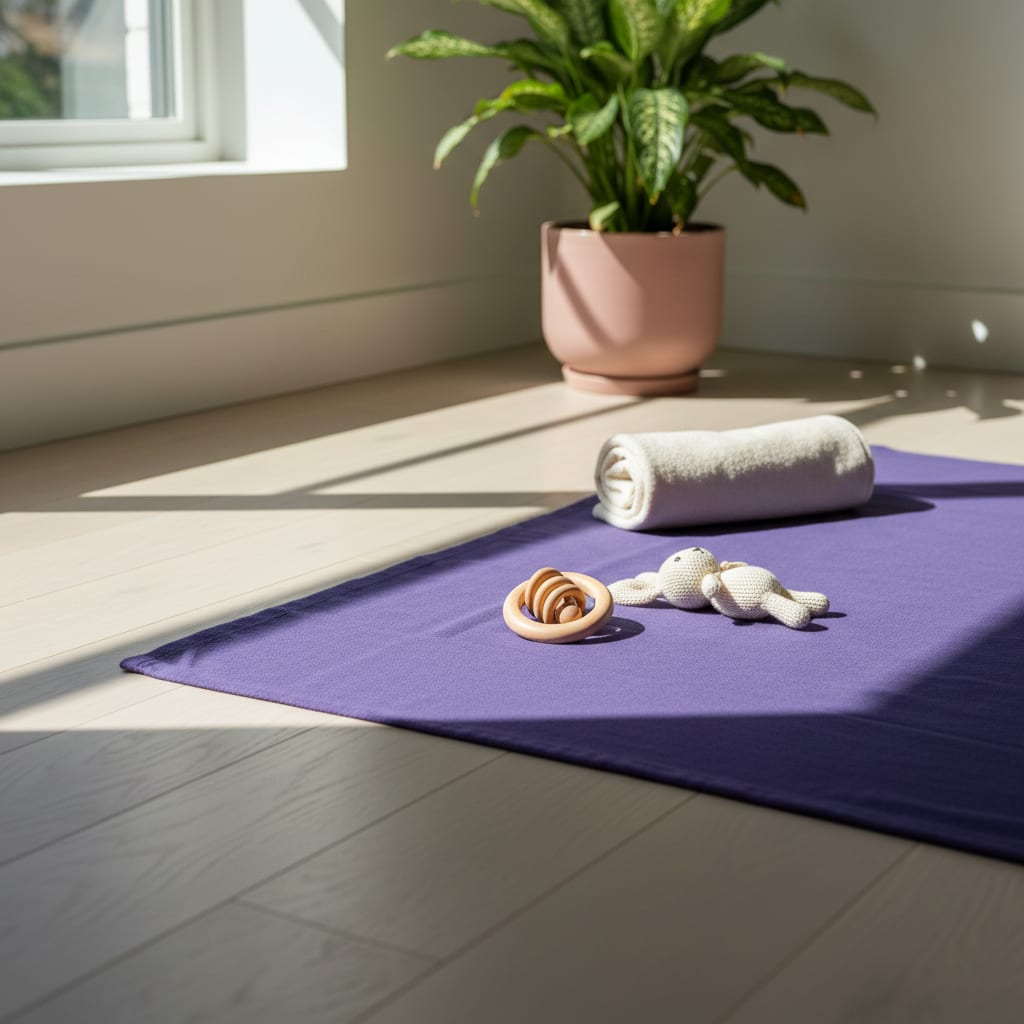
Tummy time is recommended from the first days home: the AAP suggests two to three short sessions of 3 to 5 minutes a day, working up to 15 to 30 minutes a day by about 7 weeks, and the WHO asks for at least 30 minutes spread across the day for babies who are not yet mobile. Whether it improves night sleep is a different question, and the honest answer is that nobody knows yet. The research on babies is thin, mostly observational, and does not point clearly in either direction. Do floor play because it builds strength. Don’t count on it to fix nights.
How much tummy time a baby needs, by age
The main sources agree on the shape and differ a little on the numbers, so don’t feel behind if one page sounds stricter than another.
| Age | What the guidance says | Where it comes from |
|---|---|---|
| First days home | Two or three short sessions a day, 3 to 5 minutes each, while awake and watched | AAP (Back to Sleep, Tummy to Play); NIH Safe to Sleep |
| About 7 weeks | Work up to 15 to 30 minutes a day in total | AAP |
| About 2 months | 15 to 30 minutes of total tummy time daily | NIH Safe to Sleep |
| Not yet mobile | At least 30 minutes on the tummy, spread through the day, as part of “interactive floor-based play; more is better” | WHO guidelines for under-5s |
| Rolling and moving | Structured sessions matter less as the baby moves on their own | Betteroo, below |
Minutes add up across the day, and the total grows as your baby does. For a month-by-month picture, Betteroo has a version of these ranges that runs through six months. It is plain that they are “guidelines, not benchmarks,” and that once a baby rolls and moves freely, “movement replaces practice.”
The WHO adds one more line for babies: they should not be “restrained for more than 1 hour at a time,” naming strollers, high chairs and being strapped on a caregiver’s back. At home, that rule can matter more than the minutes.
Does daytime floor play change night sleep?
The evidence on babies is very thin. A 2020 systematic review in Sleep Medicine Reviews (Janssen and colleagues) pulled together studies on movement and sleep in children under five. For babies under one, it found one study on floor-based play. In that study, babies with more floor play had shorter total sleep and less daytime napping, but slept more efficiently. That is one study, and the evidence was rated very low quality. The authors note that most of the studies they reviewed were cross-sectional, so “cause and effect could not be established.” They also raise the reverse explanation: a poor sleeper may simply move less.
The clearer link is in older children. The same review found that more outdoor play and more vigorous activity went with better sleep in toddlers and preschoolers. Don’t borrow that finding for a two-month-old.
Betteroo says the same thing. Its tummy-time guide suggests that active play “can contribute to healthy fatigue, which may support rest later on,” and then adds, “there’s no guarantee that more tummy time equals better sleep.”
The WHO treats it as one day, not a trade. Its guidance puts movement, time strapped in, and sleep (14 to 17 hours at 0 to 3 months, 12 to 16 hours at 4 to 11 months, naps included) into a single 24-hour picture. On a home day, more floor time usually means less seat time.
So the useful question is not “will tummy time fix tonight?” but “does my baby get regular floor time and time out of the seats?” That one you control.
Why this feels different once you’re home all day
When a daycare room or a nanny had your baby for part of the day, floor time was partly their job. Now every awake window is yours, and so is the laundry and the phone call you need to make. In the first week at home, the easy fix for all of that is the bouncer, the swing or the car seat parked on the kitchen floor.
None of those are bad in short stretches. But the AAP’s Back to Sleep, Tummy to Play page asks parents to “limit time spent in freestanding swings, bouncy chairs and car seats,” because they add pressure to the back of the head, and the WHO’s one-hour limit is easy to pass without noticing on a busy morning. The real trade-off at home is floor time versus seat time, a few minutes at a time.
How to fit tummy time into a day at home
You don’t need a block on a schedule, just a few hooks in the day you already have.
- After a diaper change or on waking from a nap. Both the AAP and NIH name these as good moments for a session.
- Inside the feed, play, nap cycle. If your days run loosely as feed, then awake time, then nap, tummy time belongs in the middle. That is the order in the feed-first rhythm Betteroo describes, which also says never to delay a feed to protect the pattern.
- On your chest. The AAP lists lying back with your baby on your chest as tummy time. It counts, and it lets you sit down.
- Where you work. Put a blanket on a clear patch of floor in the room you spend the morning in. NIH suggests a rolled-up towel under the arms for a little lift.
- With an older sibling watching. The AAP suggests a young child can play with the baby on the floor, “while keeping watch.” You are still the one keeping watch.
- Adjust when they protest. Fussing is normal at first. Betteroo suggests shorter sessions, chest-to-chest instead of the floor, or getting down at eye level, and notes that even 20 to 30 seconds, repeated a few times a day, builds tolerance.
If naps are what is falling apart, floor time is not the fix. A nap that stops after one sleep cycle has its own causes, covered in the 45-minute nap ceiling. If naps are the real problem and nights are fine, nap training as its own project is the next read, not more floor time.
The safety line: back to sleep, tummy to play
This is the one rule here that does not flex. NIH defines tummy time as placing a baby on their stomach “while they are awake and someone is watching them.” Sleep is different. The AAP says to “always place babies on their backs to sleep, even for short naps,” on a firm, flat surface with no soft objects.
So if your baby dozes off during tummy time, roll them onto their back and move them to their crib or bassinet. Don’t let them nap on the play mat or the sofa, or on your chest if you might fall asleep. And a rolled towel or small pillow is a prop for supervised awake play only, never something to leave in the sleep space.
When to ask your pediatrician
Ask at the next visit, or sooner, if your baby always turns their head the same way, a flat spot is not improving, or tummy time seems painful rather than just hard work. The AAP notes that a flat spot from back sleeping usually rounds out as babies grow and sit up, but it is worth having someone look.
 Where does floor time fit in your baby's day?
A short quiz turns your baby's age and current sleep into nap timing and awake windows, so you can see where play fits around them.
Take the sleep quiz →
Where does floor time fit in your baby's day?
A short quiz turns your baby's age and current sleep into nap timing and awake windows, so you can see where play fits around them.
Take the sleep quiz →
FAQ: tummy time and sleep
Does tummy time make babies sleep better at night?
There is no good evidence either way. The research on babies is a single observational study with mixed results. Do tummy time for strength and head shape.
Can my baby nap on their tummy if they fall asleep during tummy time?
No. Tummy time is for when your baby is awake and watched. If they fall asleep, put them on their back in their own sleep space, even for a short nap.
Does holding my baby on my chest count as tummy time?
Yes. The AAP lists it, and Betteroo counts lying across your lap too. What matters is that your baby is awake, on their front and working against gravity.
Is it too late to start tummy time at three months?
No. Start short and build up. Betteroo’s guide says starting later “does not mean you’ve caused harm.”